
Catch-up 1 of 4
Educational 2.0: rebuilt from the ground up in four months.
On 1 July we decided to rebuild ALYT Educational from the ground up. The first version ran in production four days later, and on 22 September our pilot schools switched to it. In 1.0 a student chatted with a patient and filled in a form, and AI produced the score. In 2.0 the patient lives on a clock and changes with every decision, and code computes the score.
In this chapter
- 01A patient who lives
- 02Reasoning first, and an honest score
- 03Feedback on the thinking itself
- 04Orders, imaging and treatment
- 05A shift, not a list of cases
- 06Learning that adds up
- 07Built for schools
- 08Fast, private and built to last
A patient who lives
In 1.0 a case was a form. In 2.0 the patient is alive: time runs, findings have to be earned, and the patient gets better or worse with every decision.
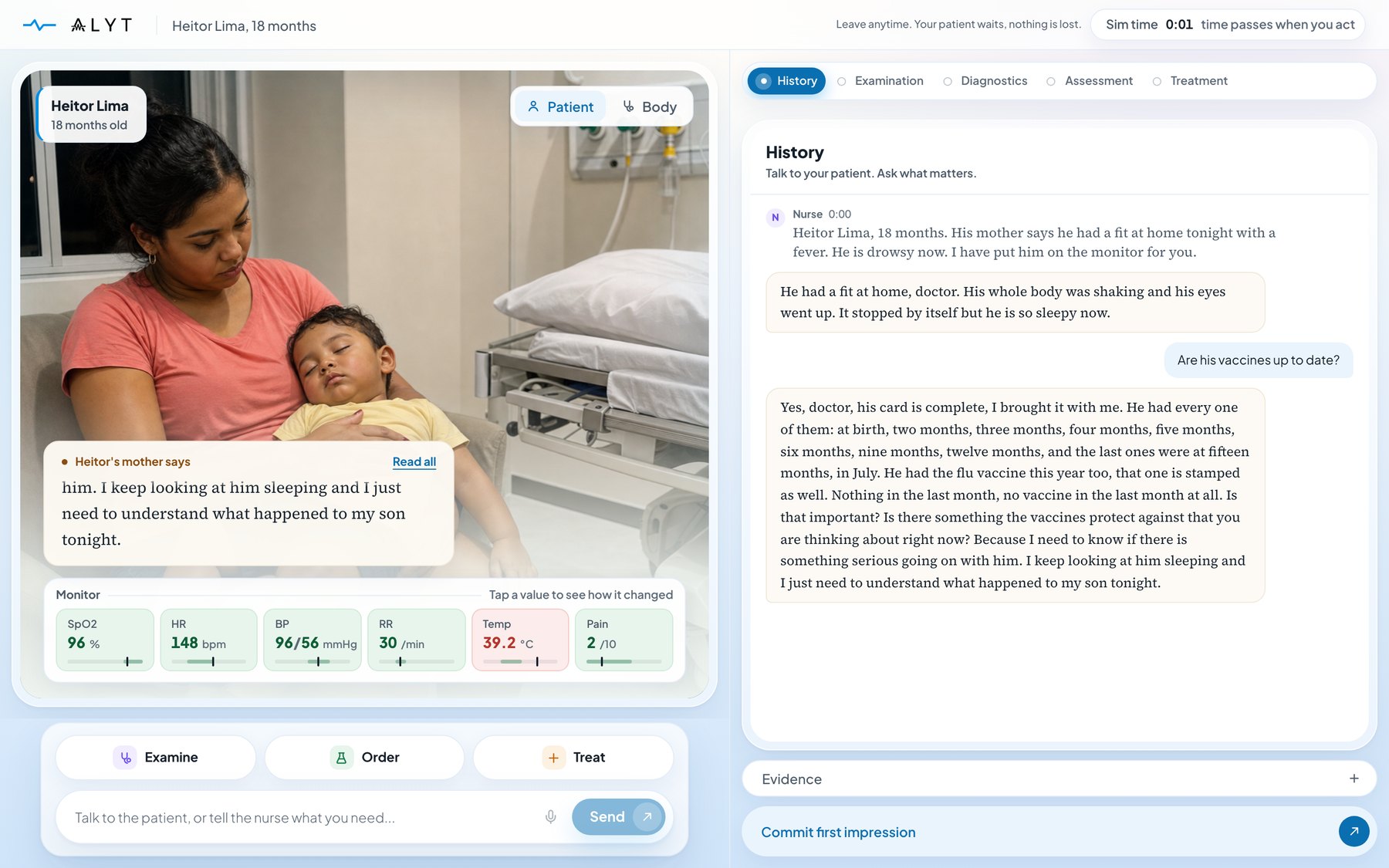
A finding exists only once the student examines the right place or orders the right test. Nothing is listed in advance.
Thinking is free, acting costs time. Results return after their real turnaround, and the patient worsens or recovers by state.
Photorealistic portraits follow the patient's condition. Students only see images a physician approved.
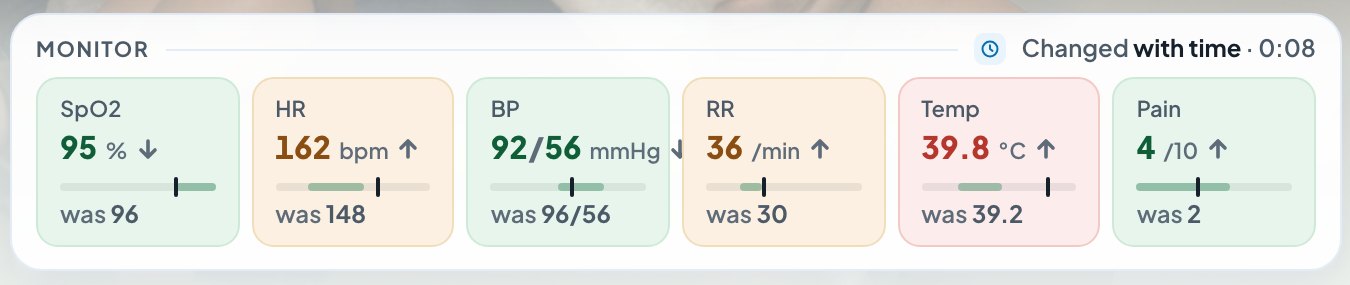
Every vital sign shows what it was, what changed it and its normal range for the patient's age.
The student picks a body part, then a technique, on an adult in bed, a child, or a baby in a cot.
A parent speaks for a young child, with ages in weeks and months and alarms set by age.
Reasoning first, and an honest score
The core of 2.0 is a loop that measures how a student thinks: commit first, live with the consequences, and get a score that code computes the same way every time.
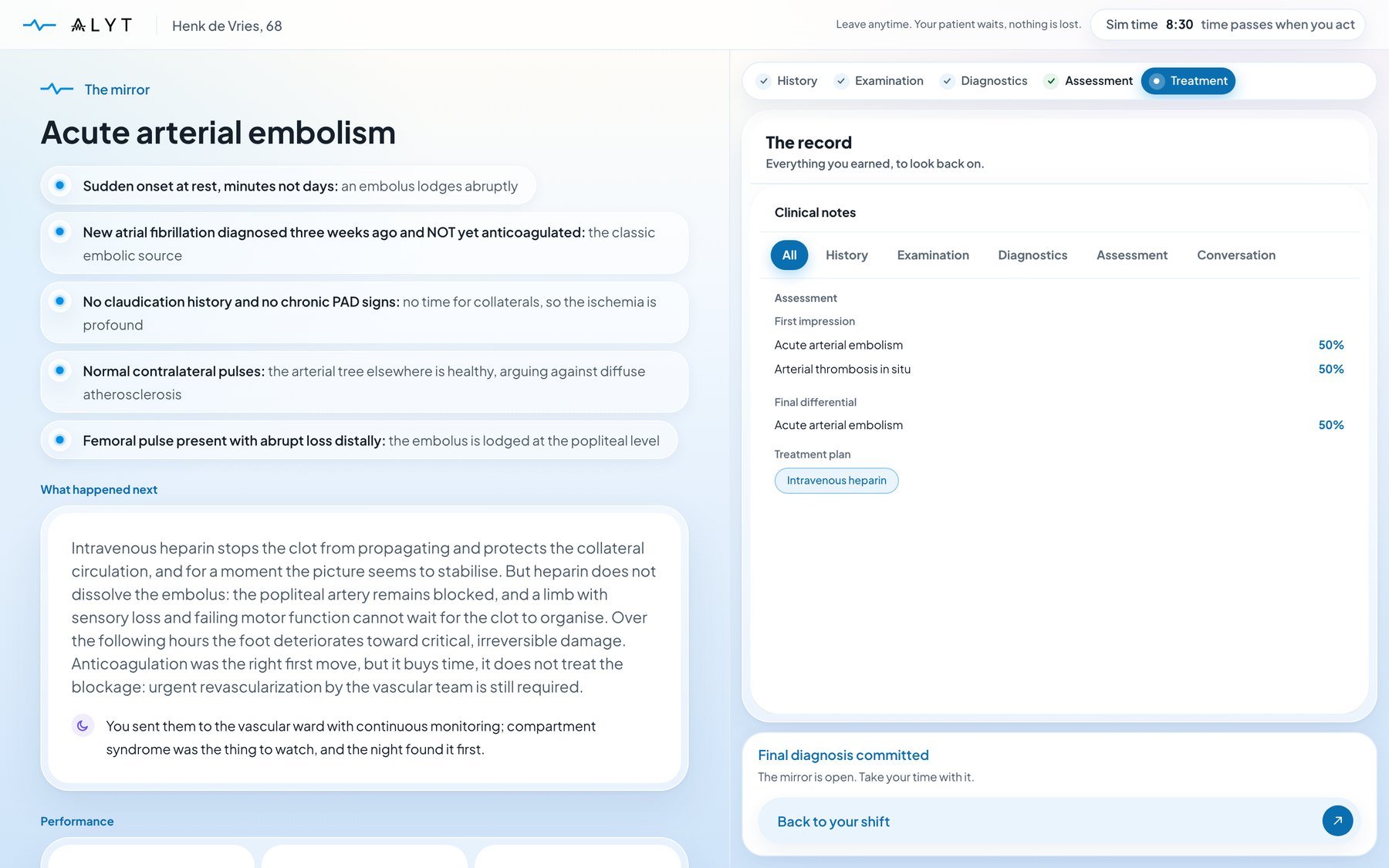
Before any test result, the student commits a first impression with a probability on each diagnosis.
After the final plan, the case plays out the path that plan earned: recovery, or the complication it missed.
Seven dimensions, from information gathering to aftercare, computed by versioned code from what the student did. AI writes the words; it does not produce the score.
The diagnosis never reaches the student's browser before the case is finished. Automated tests check this on every change.
Tests are scored against what was indicated, a harmful act never starts the treatment clock, and no test can be the right answer.
Feedback on the thinking itself
After every case the student sees not only what went wrong, but which reasoning error caused it, and what to do differently next time.
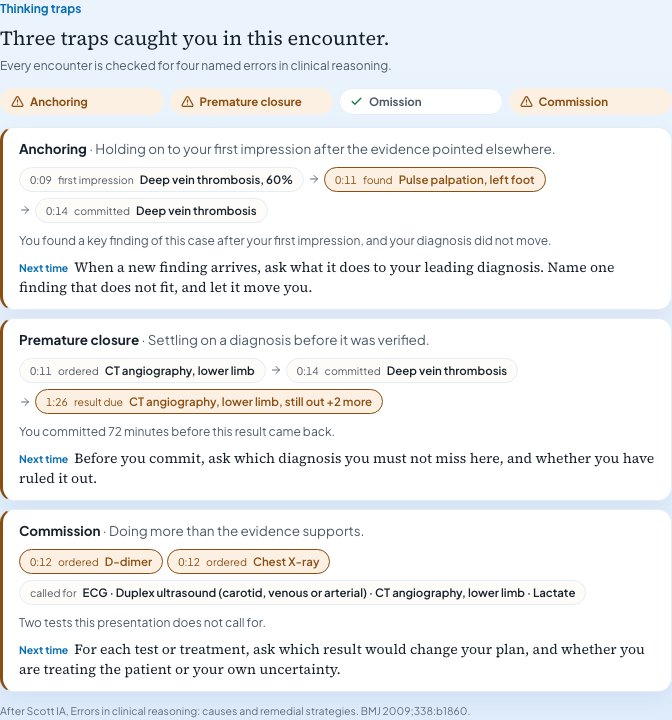
The debrief names which of four classic reasoning errors the student fell into (anchoring, premature closure, omission, commission), shows the path through their own actions and gives a strategy for next time. Teachers see how often each occurs. We have not seen this in a competing product.
The debrief: the reveal, the seven scores, what the student never found, and a professor's narrative written around the computed numbers.
After the diagnosis the student decides where the patient goes and what to watch overnight. The night passes and one morning consequence follows.
Short questions after each case, approved together with the case, then spaced review after 1, 3, 7 and 21 days.
Orders, imaging and treatment
Students order and treat the way they would on a ward, and read the results themselves. Participants of the 2026 European Vascular Course asked for real CT and MRI; since 11 October it is in the product.
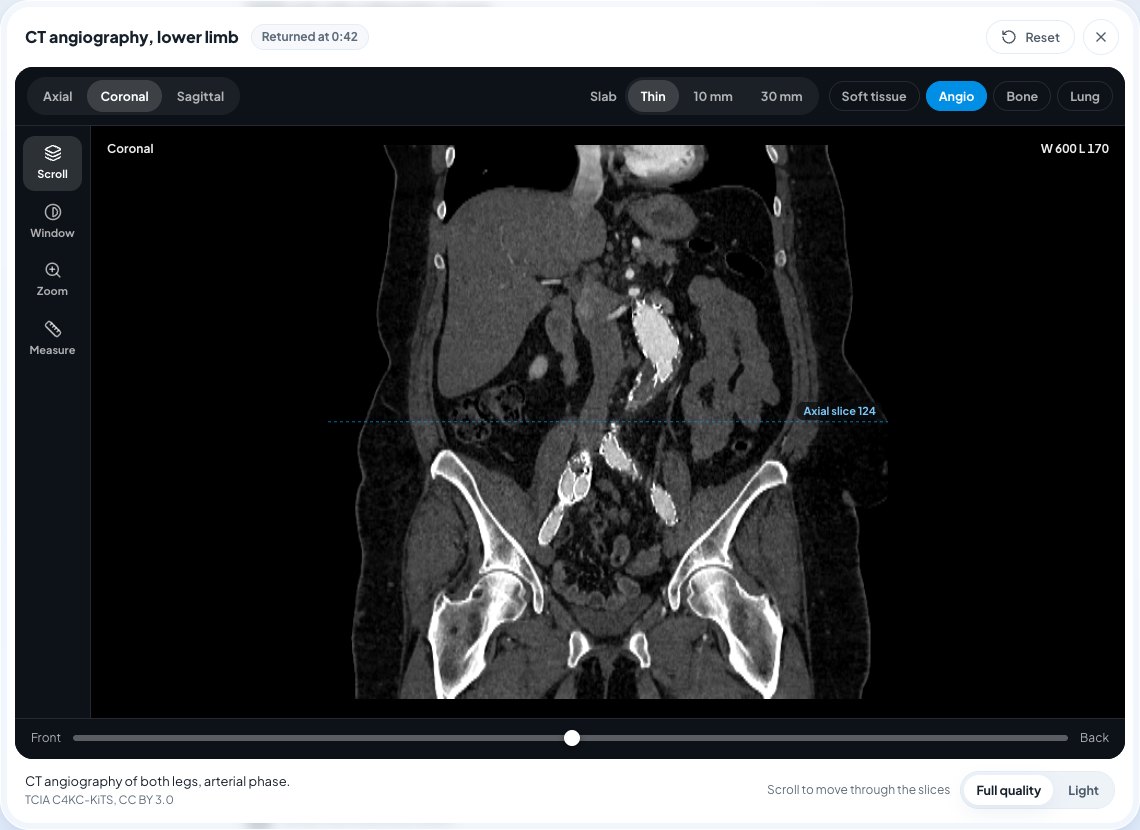
Treatments grouped by ABCDE, tests by the question the student wants answered. Search also understands Portuguese and Dutch.
Students scroll slices, set the window, zoom and measure in millimetres, with coronal and sagittal views. A light version runs on weak laptops.
If the student chose a procedure, the video of that procedure appears after the case.
Teachers can add their own scans and videos. Personal data are removed in their own browser before anything is uploaded.
The student gives several orders at once; the nurse carries them out in order and reads them back. Her model was chosen on a measured test: 92.5% exact on 165 sentences.
A shift, not a list of cases
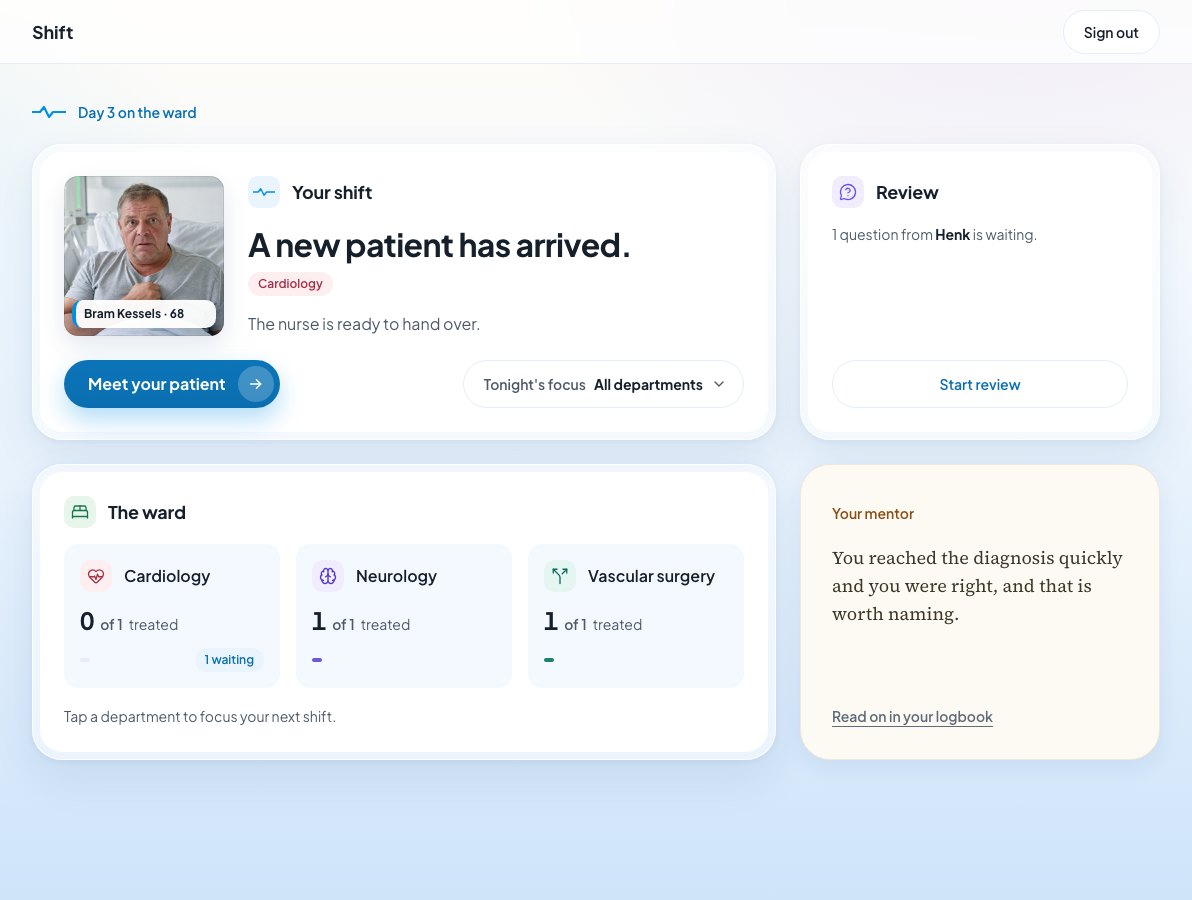
Students do not browse for a case. They start a shift and the next patient is waiting, chosen for what they need to practise.
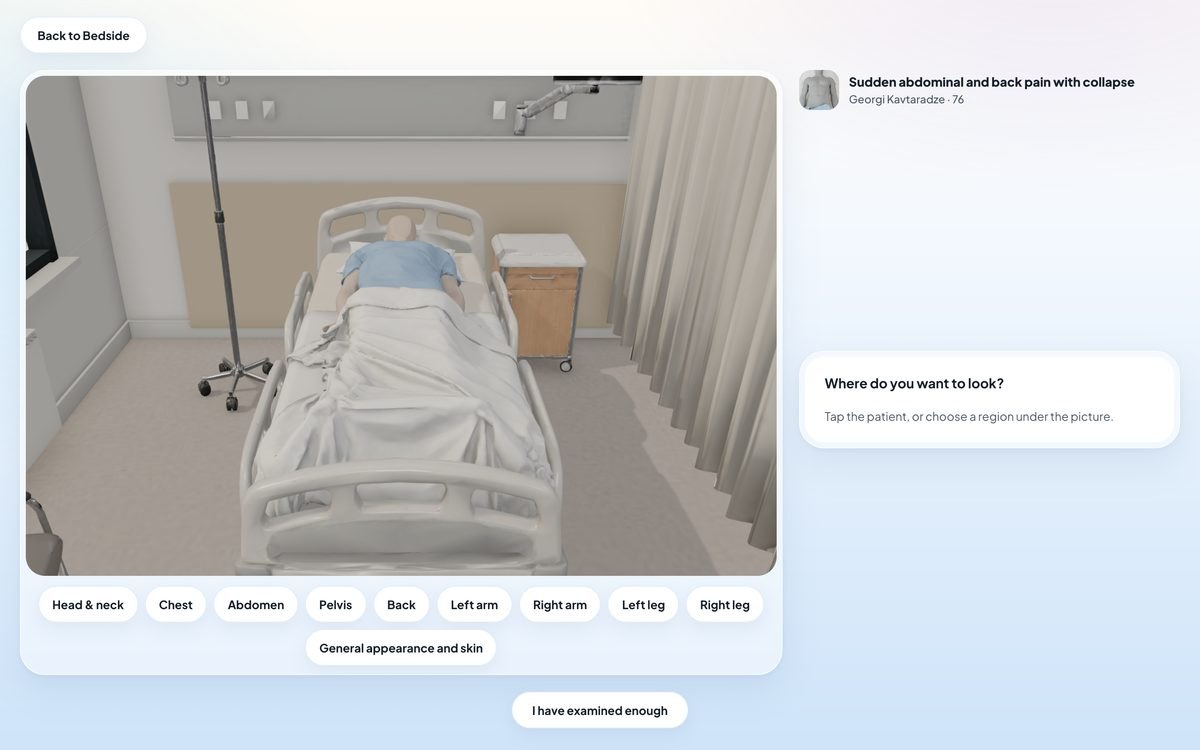
The shift picks the next patient, with a difficulty ramp and a spread across specialties.
The next patient targets the student's weak spots, and the mentor explains why in one line.
A workday start: the day on the ward, the arriving patient's portrait, the review queue and the mentor's line.
Examine the patient on physician-approved close-ups, or in a 3D hospital bed on capable devices.
Learning that adds up
Every patient a student treats builds a record of how their reasoning grows, and that record shapes what comes next.
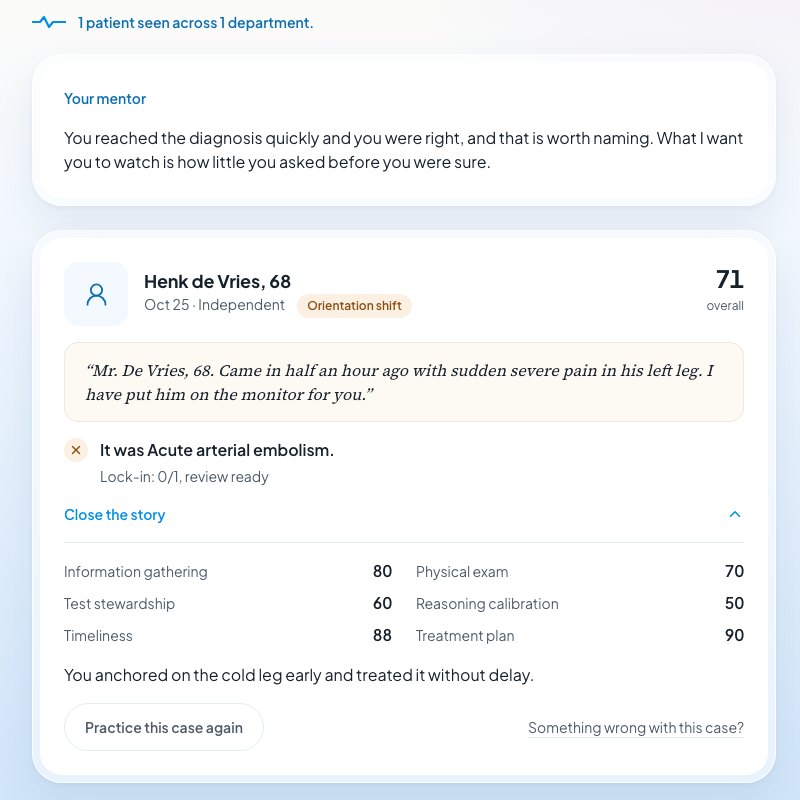
Every patient as a story card: what the student committed, what it was, what they missed, and the scores.
A short remark after each case, built on a competence model. It follows up on its own advice and writes a growth chapter every five cases.
A repeated mistake is confirmed only on enough evidence, and then shapes the mentor and the choice of the next patient.
The simulation's scores in the Mini-CEX vocabulary that schools use for bedside assessment.
Built for schools
2.0 is built to be licensed by schools: one physician-reviewed library, cases built to a school's own curriculum, and teacher tools on the same data.
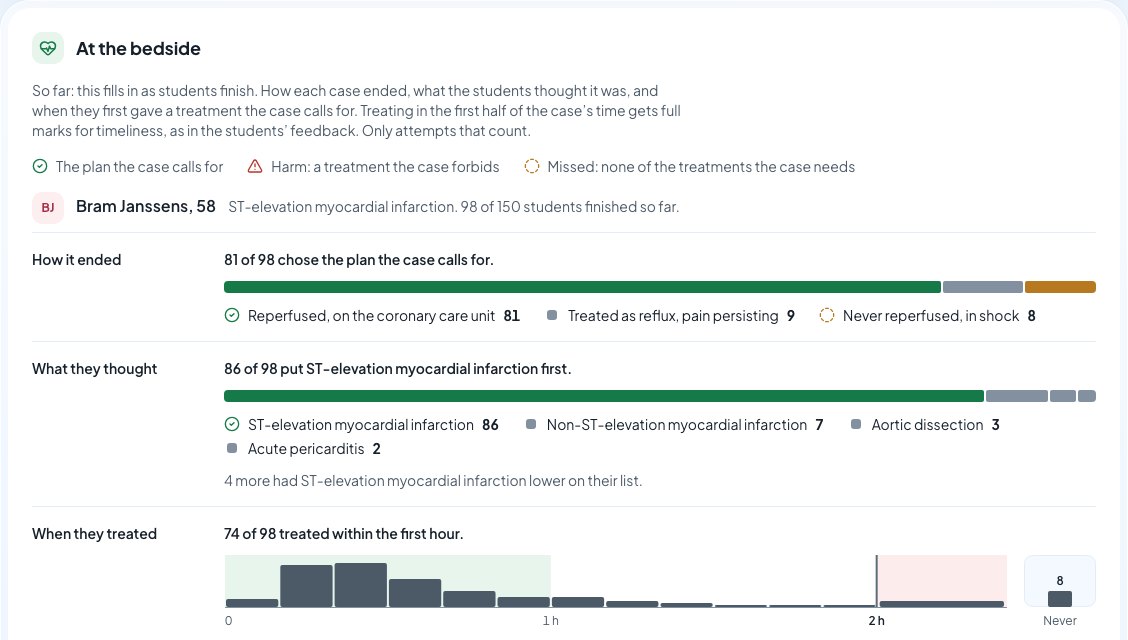
ALYT keeps one physician-reviewed library. Each school licenses all of it or chosen patients, and owns the cases it authors.
From source material and a level, the AI drafts a complete living case in minutes. The author plays it in the student view and steers it in plain language.
No case is published until a physician who did not write it approves that exact version on a 15-item checklist, after an AI critic checks 17 points.
Fifteen paediatric cases built on topics chosen by partner faculty, the first five live. A new school's pneumonia case went from request to publication in three days.
Assignments with deadlines, each student's reasoning path, the week's teaching findings, and export.
Fast, private and built to last
Schools buy trust. 2.0 is fast on a cheap laptop, hosted in the EU and guarded by more than 12,000 automated tests.
Every click in the student platform answers in 11 to 22 ms on production, down from 112 to 253 ms before the speed work.
Database, storage and servers in Dublin. The AI and login providers process data in the US under processing agreements.
Consent inside the platform, pseudonymised study exports, and the answer key kept on the server.
52 documents for an information security management system, aligned to ISO/IEC 27001:2022.
Up from 1,743 when 2.0 started. They run on every change before it reaches production.
One raster, six type sizes and one card anatomy across every student page, built for phones.
What comes next
Next week, catch-up 2 of 4: customers, from the first pilots to 14 institutions.